
The best golfers swing at different speeds, but with the same rhythm.
Tempo and rhythm are two different numbers. Why rhythm decides the moment of impact, and how to measure your own.
- rhythm
- tempo
- practice
- short game
Fred Couples looks unhurried, Jon Rahm looks rushed. Measure their swings, and for both of them the backswing takes about three times as long as the downswing to impact. That ratio is the rhythm, and it is something the best players in the world almost all agree on.
Tempo and rhythm are two different numbers
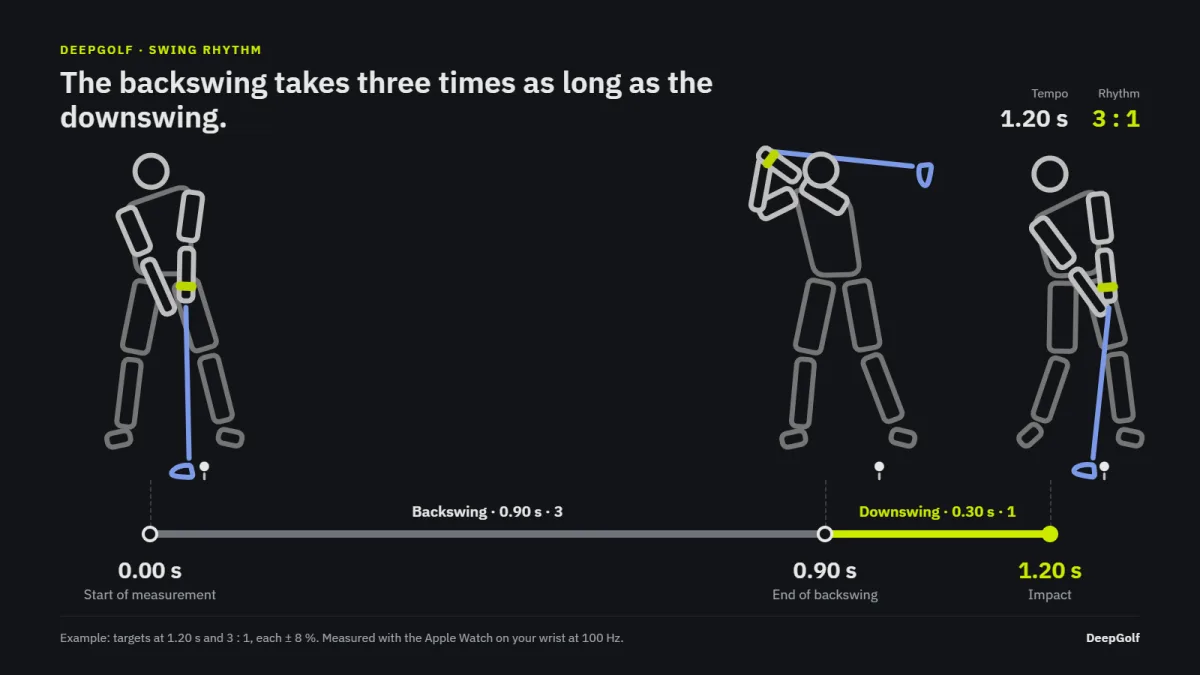
Tempo is the total duration of the swing. Rhythm is the ratio between its two phases:
tempo = backswing + downswing
rhythm = backswing / downswing
On tour, the backswing usually takes between 0.70 s and 0.90 s, the downswing between 0.23 s and 0.30 s. So tempo varies, but the ratio barely does: almost everyone sits close to 3 : 1. John Novosel first found this by counting video frames, and Yale physicist Robert Grober later confirmed it with sensors in the club. He also found that professionals barely vary from one swing to the next.
Rhythm holds the movement together
The downswing is a chain: ground, hips, torso, arms, club. Each link needs its time. If the backswing is too slow, often at 4 : 1 or more, the swing loses momentum at the top and the arms have to make up for it. If the transition is rushed, the arms overtake the lower body. Thin strikes and out-to-in swings are the typical result.
The duration is surprisingly stable too: for good players, a wedge swing takes hardly less time than a driver swing. One rhythm is enough for every club.
Around the green, it's closer to 2 : 1
On chips, pitches, bunker shots and putts, the backswing takes about twice as long as the forward stroke. Good putters take roughly the same time for short and long putts. The distance comes from the length of the backswing. Typical mistakes are a short backswing followed by a jab, or a long one followed by slowing down.
Skill shows in the spread
Professionals stay tightly around 3 : 1, swing after swing. In recreational golfers the values spread widely, often between 3.5 : 1 and 4 : 1, almost always because the backswing is too slow. The old advice to "take it back slowly" has led many players right there. If you're less flexible, a longer total time is fine, as long as the ratio holds.
Under pressure, rhythm is the first thing to go: on the first tee or in front of water, the backswing gets shorter and the transition quicker. The technique hardly changes, but the timing does.
Feel is too coarse for this
If a 0.30 s downswing gets 0.05 s longer, the ratio drops from 3 : 1 to about 2.6 : 1. Hardly anyone can feel five hundredths of a second. Even total time can mislead: 0.78 s up and 0.42 s down adds up to exactly 1.20 s, but the ratio is below 2 : 1. The sum is right, the swing isn't.
How the app measures your rhythm
DeepGolf Rhythm measures on your wrist with the Apple Watch at 100 Hz and scores backswing and downswing separately. You don't need a camera or an extra sensor. You set total time and ratio, and the app calculates the targets: at 1.20 s and 3 : 1, that's 0.90 s and 0.30 s, each with a range of ± 8 %. For the short game, set it to 2 : 1.
After each swing, the watch shows both times and a sentence like "Backswing too short". On the iPhone, each swing appears as a dot in a chart, backswing against downswing. That way you quickly see whether your dots sit close together or scatter.
For your next session
Hit ten balls with the watch on and change nothing. See where your ratio lands and how widely your dots spread. Then pick a target: 3 : 1 for full swings, 2 : 1 for the short game, and a total time that doesn't feel rushed.
It also works without a ball, in the garden or the living room for example. A short club and enough room overhead are all you need. Without a ball flight to watch, you can focus fully on the beat, which makes this the best way to practise it.
Wear the watch one notch tighter than usual, or it measures your arm rather than your swing. If you practise with the metronome, just listen to the beat for the first few swings and only then look at your wrist.
You can work through how the targets are derived on the measurement page. DeepGolf Rhythm is on the App Store.